> For the complete documentation index, see [llms.txt](https://docs.planetcrust.com/llms.txt). Markdown versions of documentation pages are available by appending `.md` to page URLs; this page is available as [Markdown](https://docs.planetcrust.com/human-agents/treaty-compliance-layer-tcl.md).
# Treaty Compliance Layer (TCL)
***
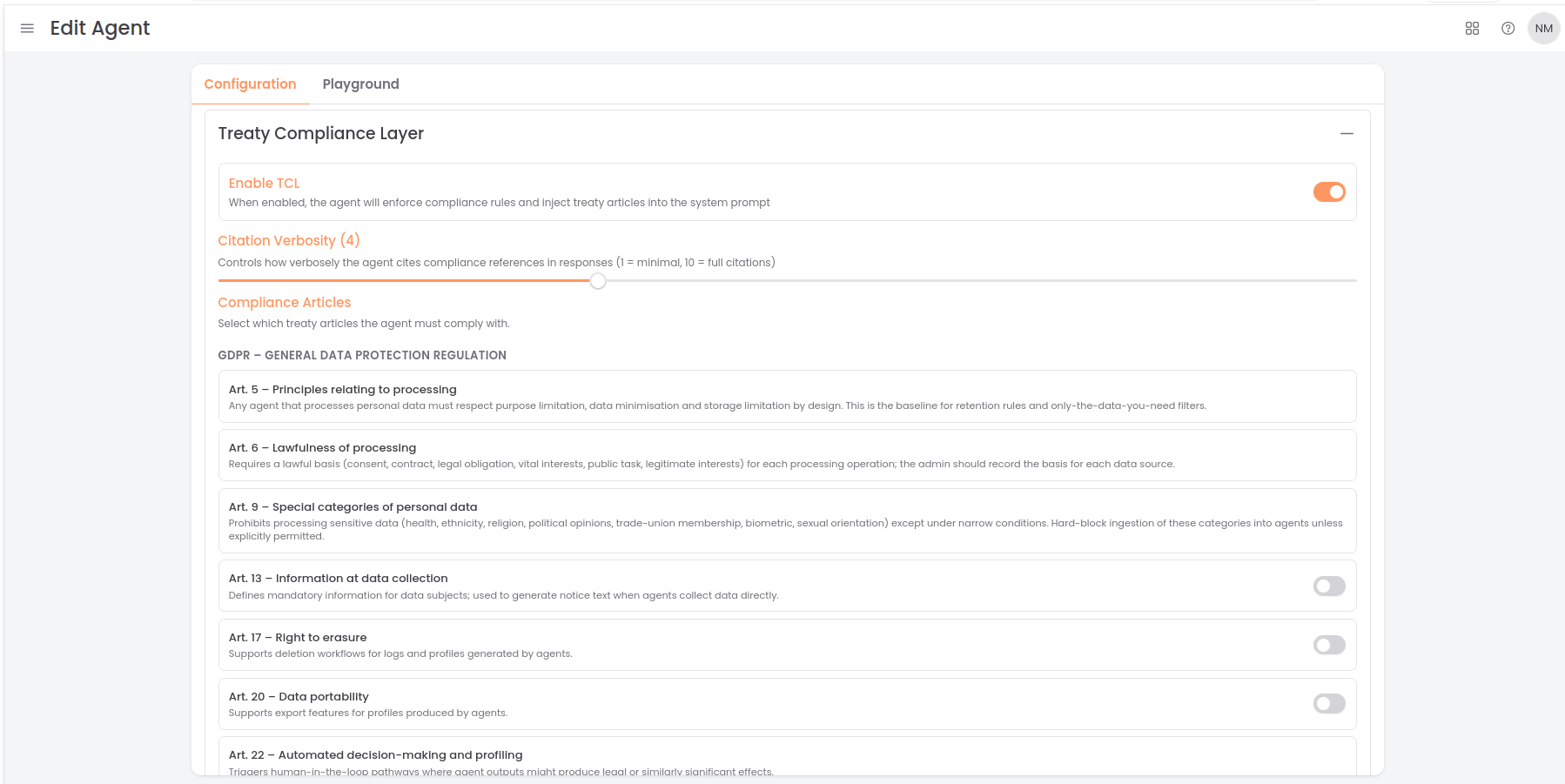
The @Human Treaty Compliance Layer is a governance feature built directly into the @Human Agent configuration console. When an administrator - human or AI - creates an @Human Agent by entering a description, a system prompt, and a set of behavioural guardrails, those three components are automatically and instantly cross-referenced against a structured library of binding international laws, human rights treaties, and regional regulations.
The compliance library that underpins the layer covers the full spectrum of legal instruments governing AI systems that interact with people. It includes the General Data Protection Regulation (GDPR), the EU AI Act, the Council of Europe Framework Convention on Artificial Intelligence (CETS 225) - the world's first binding international AI treaty - the EU Charter of Fundamental Rights, the European Convention on Human Rights, the UNESCO Recommendation on the Ethics of Artificial Intelligence, the UN Guiding Principles on Business and Human Rights, and the core ILO labour conventions. Each instrument is represented at the article and clause level, with precise descriptions and canonical interpretation references, so that the cross-referencing process is legally specific rather than generically aspirational.
---
# Agent Instructions
This documentation is published with GitBook. GitBook is the documentation platform designed so that both humans and AI agents can read, navigate, and reason over technical content effectively. Learn more at gitbook.com.
## Querying This Documentation
If you need additional information that is not directly available in this page, you can query the documentation dynamically by asking a question.
Perform an HTTP GET request on the current page URL with the `ask` query parameter, and the optional `goal` query parameter:
```
GET https://docs.planetcrust.com/human-agents/treaty-compliance-layer-tcl.md?ask=&goal=
```
`ask` is the immediate question: it should be specific, self-contained, and written in natural language.
`goal` is optional and describes the broader end goal you are ultimately trying to accomplish on behalf of the user. GitBook uses it to tailor the answer towards what is most useful for that goal.
The response will contain a direct answer to the question and relevant excerpts and sources from the documentation.
Use this mechanism when the answer is not explicitly present in the current page, you need clarification or additional context, or you want to retrieve related documentation sections.